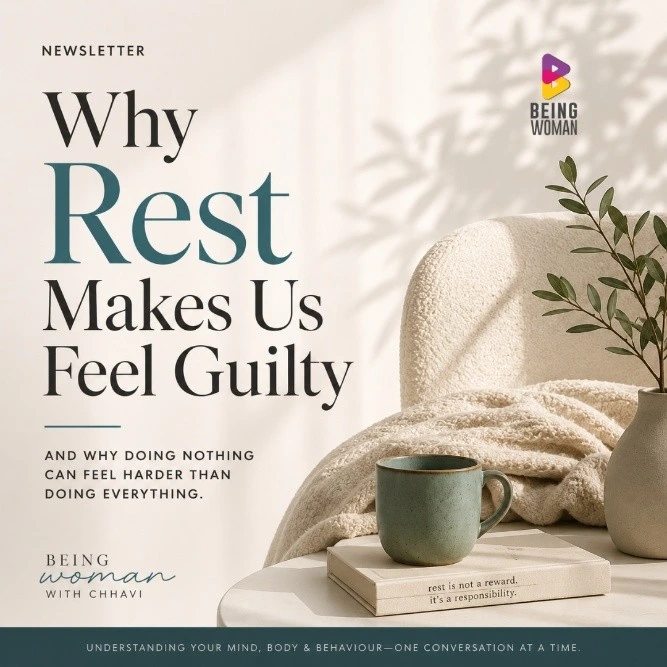
And why doing nothing can feel harder than doing everything.
We’ve become incredibly good at resting with one eye open.
We sit down, but mentally we’re still replying to emails. We watch television while folding laundry. We take a day off, yet spend half of it thinking about everything we should be doing.
Somewhere along the way, rest stopped feeling like recovery and started feeling like something we had to earn.
If you’ve ever felt guilty for lying on the couch, cancelling plans, or taking a break before everything on your to-do list was complete, you’re not lazy. You’re responding to years – sometimes decades – of conditioning that equates productivity with worth.
When did rest become something we apologise for?
Listen to how we talk about it.
“I haven’t done much today.”
“I should probably get back to work.”
“I feel so lazy.”
Notice that we rarely say, “I gave my body the recovery it needed.”
Our language reveals our beliefs.
Many of us were praised for being helpful, reliable, productive, and selfless. Over time, those behaviours became part of our identity. We didn’t just do productive things – we began to believe that being productive was who we were.
The problem is that identities are hard to switch off.
The science behind the guilt
Our brains are prediction machines. They learn patterns and repeat them.
If you’ve spent years receiving praise, recognition, or even self-satisfaction from being constantly busy, your brain starts linking activity with reward.
Every completed task gives you a small sense of progress. Sometimes that progress is accompanied by a release of dopamine, the neurotransmitter involved in motivation and reinforcement. It’s important to remember that dopamine isn’t simply a “reward chemical”; it’s more accurately part of the system that encourages us to repeat behaviours that have been valuable in the past.
So when you stop, your brain doesn’t immediately think, “Great, time to recover.”
Instead, it notices that the familiar pattern has been interrupted.
That uncomfortable feeling isn’t necessarily proof that you’re doing something wrong. Often, it’s simply your brain recognising that you’re doing something different.
Why this affects so many women
Research suggests that women continue to shoulder a disproportionate share of unpaid caregiving, household planning, and emotional labour. Even during moments that look like rest from the outside, many are still mentally organising tomorrow’s meals, remembering birthdays, planning appointments, or anticipating someone else’s needs.
This invisible work—often called the mental load—means that physical rest doesn’t always translate into mental rest.
No wonder so many women say, “I finally sat down, but I couldn’t relax.”
The irony
Rest isn’t the opposite of productivity.
It’s one of the reasons productivity is possible in the first place.
Athletes don’t become stronger during the workout itself. Much of the adaptation happens afterwards, during recovery.
The same is true for your brain.
Memory consolidates during sleep. Creativity often emerges during periods of downtime. Your nervous system needs opportunities to shift out of a constant state of alertness.
Recovery isn’t an interruption to performance.
It’s part of performance.
Try this this week
The next time you catch yourself thinking, “I should be doing something,” pause and ask a different question.
“If someone I loved were as tired as I am, would I expect them to keep going?”
Notice how easily we extend compassion to others—and how rarely we offer it to ourselves.
Then give yourself permission to rest for just ten uninterrupted minutes.
No phone.
No multitasking.
No trying to make the rest “productive.”
Just rest.
Not because you’ve earned it.
Because you’re human.
A thought to carry with you
Your value has never been measured by how exhausted you are.
Sometimes the most productive thing you can do is allow your mind and body to recover.
Reflection
What would change if you stopped treating rest as a reward and started treating it as a responsibility?
Comment below.
If you are going through any kind of trouble in life, if you feel like you need someone to talk to but are too shy to speak up, use this anonymous feature to send me a message.