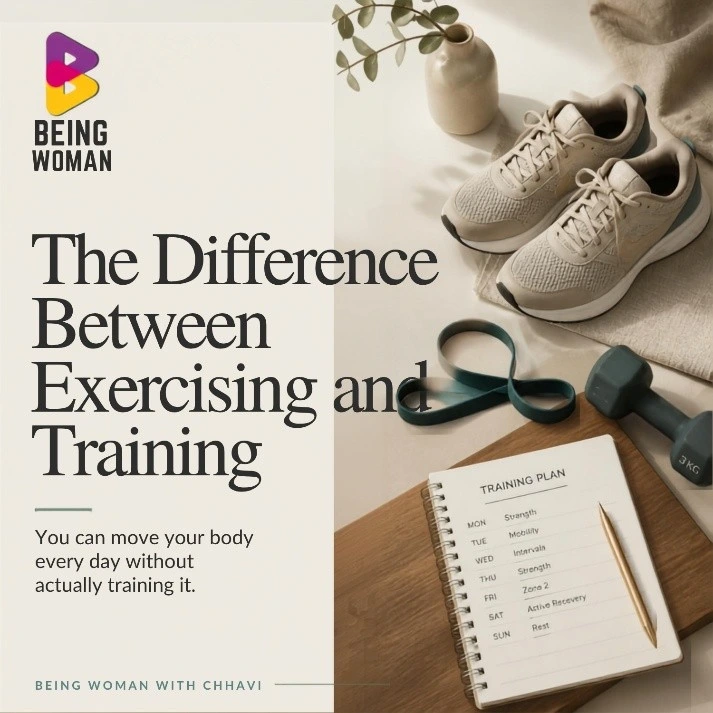
You can move your body every day without actually training it.
We tend to use the words exercise and training as though they mean the same thing.
“I exercise.”
“I train.”
“I’m working out.”
But there is an important distinction.
Exercise is movement.
Training is movement with a purpose.
Training is movement with a purpose.
You can go for a walk because you enjoy it.
You can dance because it makes you feel good.
You can swim because it’s relaxing.
You can play a sport because you love it.
All of that is exercise.
Training asks a different question:
What am I trying to make my body better at?
Getting stronger?
Building muscle?
Improving cardiovascular fitness?
Increasing mobility?
Running faster?
Recovering from an injury?
Improving balance?
Once you have a specific adaptation you’re trying to create, your workouts start looking different.
Exercise makes you feel good. Training makes you adapt.
This doesn’t mean one is better than the other.
Exercise has enormous value even when there is no measurable goal attached to it.
A 30-minute walk can improve your health.
Dancing can elevate your heart rate.
Playing with your children can get you moving.
Taking the stairs instead of the lift counts too.
You don’t need to turn every movement into a performance metric.
But if your goal is to change what your body can do, you need something more deliberate.
That’s where training comes in.
Training has an intention
Imagine two people lifting weights.
Person A does whatever exercises feel good that day.
A few squats.
Some lunges.
Some weights.
Maybe some abs.
They’ve exercised.
Person B has a goal:
“I want to get stronger at squats.”
So they track their weight.
They pay attention to technique.
They progressively increase the challenge.
They allow enough recovery.
They repeat the movement consistently.
That’s training.
The difference isn’t necessarily how hard they worked that day.
It’s the intention behind the work.
Your body adapts to what you repeatedly ask it to do
This is one of the most useful principles in fitness.
Your body responds to a stimulus.
If you repeatedly challenge your muscles with resistance, they adapt.
If you progressively challenge your cardiovascular system, your aerobic capacity can improve.
If you regularly work on mobility, your range of motion can improve.
If you practise balance, coordination can improve.
The body is remarkably responsive.
But it needs a reason to adapt.
And it needs enough consistency for that signal to matter.
This is where progressive overload comes in
You don’t necessarily need to lift heavier every single workout.
Progressive overload simply means that over time, you’re asking your body to handle a gradually increasing challenge.
That could mean:
More weight.
More repetitions.
More controlled repetitions.
A greater range of motion.
More difficult variations.
Better technique.
More volume.
Or, depending on the goal, greater speed or intensity.
The principle is simple:
If the demand never changes, the adaptation eventually plateaus.
But harder isn’t always better
This is where fitness culture can get things wrong.
Training isn’t about destroying yourself every time you enter the gym.
Your body doesn’t adapt because you suffered enough.
It adapts through a combination of:
Stimulus + recovery + nutrition + consistency.
You create a challenge.
Your body responds.
You recover.
You adapt.
Then you gradually challenge it again.
That’s why doing more isn’t automatically the same as training better.
And recovery isn’t laziness
If you’re training for an adaptation, recovery becomes part of the programme.
Muscle repair happens after training.
Fitness adaptations develop over time.
Sleep supports recovery.
Nutrition provides the raw materials.
Rest allows your body to respond to the stress you’ve deliberately placed on it.
So if you’re constantly exhausted, sore and under-recovered, adding another workout isn’t necessarily the answer.
Sometimes the most productive thing you can do for your training is recover.
This matters especially as we get older
Fitness can become very different when the goal changes.
At 20, you may train because you want to look a certain way.
At 40, 50 or 60, you may still care about how you look—and there’s nothing wrong with that.
But there are additional reasons to train.
To maintain muscle.
To preserve strength.
To support bone health.
To maintain balance and coordination.
To stay capable of lifting, carrying, climbing, getting up and down, and moving through everyday life.
The goal gradually becomes less about what your body looks like and more about what your body can continue to do.
So what should you ask yourself?
Instead of:
“What workout should I do today?”
Try asking:
“What am I training for?”
If the answer is:
“I want to feel good and move more.”
Fantastic.
Go for the walk.
Dance.
Swim.
Cycle.
Play.
You are exercising.
If the answer is:
“I want to get stronger.”
Now you need a structured resistance-training programme.
If it’s:
“I want better cardiovascular fitness.”
Your training needs to progressively challenge your cardiovascular system.
If it’s:
“I want to stay mobile.”
Mobility needs to become intentional.
The goal determines the training.
You don’t need to turn your whole life into a training plan
This distinction isn’t meant to make fitness more complicated.
Quite the opposite.
It can make it simpler.
You don’t have to optimise every workout.
You don’t need to train seven days a week.
You simply need to know what you’re trying to achieve.
Some days can be training.
Some days can be exercise.
Some days can be rest.
And sometimes, moving because it feels good is exactly what your body needs.
The bigger lesson
Exercise helps you move.
Training helps you adapt.
Both matter.
The mistake is expecting one to do the job of the other.
A daily walk can be fantastic for your health.
But if your goal is to build strength, walking won’t replace progressive resistance training.
And a heavy strength session can be fantastic for building muscle.
But that doesn’t mean you should stop walking, playing, dancing or simply enjoying movement.
A healthy body needs both purposeful challenge and enjoyable movement.
A thought to carry with you
Don’t just ask yourself how much you exercise. Ask yourself what you’re training your body to be able to do.
Reflection
The next time you plan a workout, finish this sentence:
“I’m training because I want my body to…”
The answer may change the way you train.
If you are going through any kind of trouble in life, if you feel like you need someone to talk to but are too shy to speak up, use this anonymous feature to send me a message.


1 thought on “The Difference Between Exercising and Training”
This is nice 🤗