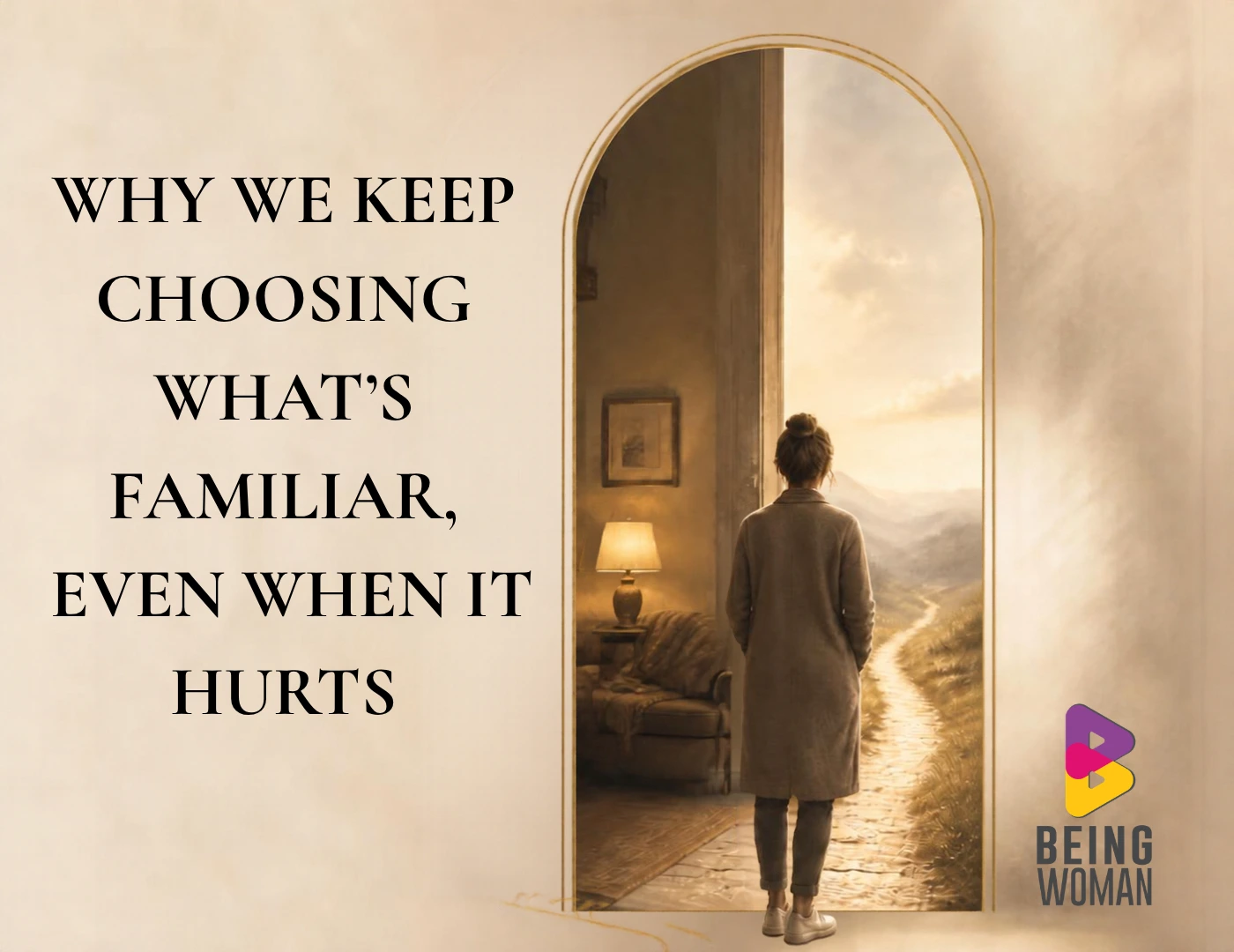
Have you ever stayed in something you knew wasn’t good for you?
● A relationship.
● A job.
● A routine.
● A friendship.
● A way of thinking about yourself.
You know it isn’t working. You even say: “I know I need to change.”
And then somehow…
you go back.
It’s easy to assume this happens because people don’t know what’s good for them.
But sometimes the problem is more uncomfortable than that:
Your brain can prefer the familiar over the unknown; even when the familiar isn’t particularly good.
Familiar doesn’t necessarily mean safe
Something can be familiar because you’ve experienced it repeatedly. That doesn’t automatically make it healthy.
- A chaotic environment can become familiar.
- Being criticised can become familiar.
- Overworking can become familiar.
- Emotionally unavailable relationships can become familiar.
- Avoiding difficult conversations can become familiar.
And once something becomes familiar, you don’t have to spend as much mental energy figuring out what happens next. You know the pattern. You know the rules. You know what to expect. And predictability has value.
Your brain learns patterns
A large body of habit research shows that repeated behaviours in recurring contexts can become increasingly automatic. Habits are strongly tied to the contexts and cues in which behaviours repeatedly occur.
You feel uncomfortable, you reach for your phone.
You feel rejected, you withdraw.
You feel overwhelmed, you procrastinate.
The behaviour may not solve the underlying problem. But it is familiar. And familiarity means your brain already knows the sequence.
Then there’s the reward
Some behaviours are repeated because they provide immediate relief. Avoiding a difficult conversation can reduce anxiety right now. Checking your ex’s social media can temporarily reduce uncertainty.
Going back to a familiar relationship can relieve the discomfort of being alone. Procrastinating can give you a brief escape from an overwhelming task.
The long-term consequence might be unpleasant. But the immediate effect can still reinforce the behaviour.
That’s one reason simply telling yourself: “This is bad for me” doesn’t always make it easy to stop. You aren’t only fighting a belief. You’re fighting a learned pattern.
And attachment can make familiarity even more complicated
Human beings are built for connection. Our early relationships help shape expectations about closeness, safety and how relationships work.
Attachment research has explored how experiences with caregivers contribute to internal working models; mental representations that can influence expectations and behaviour in later relationships.
This doesn’t mean: “Your childhood determines every relationship you will ever have.”
It doesn’t. People change. Relationships change.
But it does help explain why a relationship dynamic can feel strangely compelling even when you consciously know it isn’t what you want.
Sometimes you’re not only attached to the person. You’re attached to the pattern.
Give more examples to this
Predictability can feel safer than possibility
Imagine two options.
Option A:
You know exactly what happens.
It isn’t particularly good.
But it’s predictable.
Option B:
You don’t know what happens.
It could be much better.
It could also be worse.
Which one feels psychologically easier?
For many people, the second option creates more discomfort simply because it contains uncertainty.
And uncertainty itself can be experienced as threatening, particularly for people who have a high intolerance of uncertainty.
So you might choose a known pain over an unknown possibility. Not because you consciously prefer suffering. Because your brain knows how to navigate the familiar.
This is why change can feel wrong before it feels right
When you leave an old pattern, you’re not immediately rewarded with comfort.
Sometimes you get the opposite. You feel awkward. You question yourself. You miss the old routine. You wonder whether you’ve made a mistake.
That’s because familiarity doesn’t disappear from your nervous system just because you made a rational decision. Your brain needs time to learn a new pattern.
And new patterns require repetition.
The answer isn’t to fear familiarity
Familiarity is useful.
- Habits save mental energy.
- Routines can create stability.
- Predictability can make life easier.
The problem is when familiarity becomes your main criterion for deciding what deserves to stay.
“At least I know what I’m getting.” isn’t always a good reason to keep getting
The bigger lesson
Growth often requires entering territory your brain hasn’t mapped yet.
A new relationship.
A new career.
A new routine.
A new boundary.
A new way of speaking to yourself.
At first, it can feel uncomfortable precisely because it isn’t familiar. That discomfort isn’t necessarily evidence that you’ve made the wrong choice. Sometimes it’s simply evidence that you’re learning something new.
You don’t have to keep choosing something simply because your brain already knows how to survive it. Sometimes the life you want begins where the familiar one ends.
What are you calling “comfort” simply because you’ve become accustomed to it?
If you are going through any kind of trouble in life, if you feel like you need someone to talk to but are too shy to speak up, use this anonymous feature to send me a message.