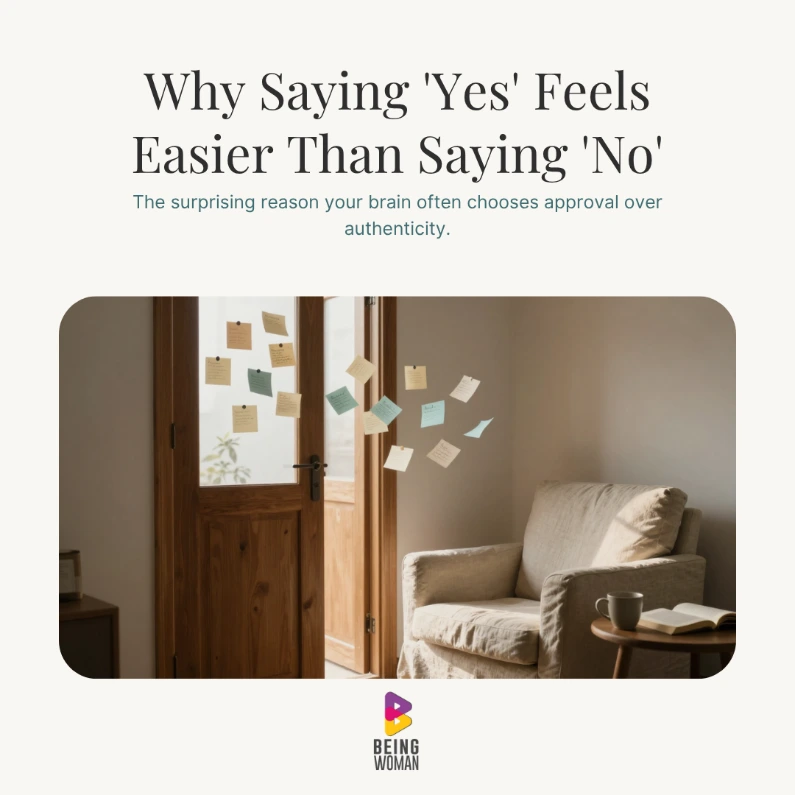
The surprising reason your brain often chooses approval over authenticity.
How many times have you said “yes” when every part of you wanted to say “no”?
Yes to one more meeting.
Yes to helping someone when you were already overwhelmed.
Yes to attending an event you didn’t want to go to.
And then, almost immediately, you regretted it.
If this sounds familiar, you’re not weak. You’re not indecisive. And you’re certainly not alone.
Sometimes, saying “yes” has less to do with generosity and more to do with what your brain believes will keep you safe.
The discomfort of saying no
Imagine receiving a message asking for a favour.
Before you’ve even had time to think about whether you want to help, another thought appears:
“What if they think I’m rude?”
“What if I disappoint them?”
“What if they stop asking me?”
Notice what happened.
You didn’t first consider your own needs.
You first considered the other person’s reaction.
For many of us, this process is so automatic that we mistake it for kindness.
The science behind it
Our brains evolved to survive in groups.
For most of human history, being accepted by your community wasn’t just emotionally rewarding—it was essential for survival.
Rejection carried real consequences.
Although our lives have changed dramatically, our brains still respond to social exclusion as though it matters deeply.
Research even shows that social rejection activates some of the same brain regions involved in processing physical pain.
That doesn’t mean every declined invitation is traumatic.
But it helps explain why saying “no” can feel surprisingly uncomfortable.
Why so many women recognise this feeling
Many women are raised to be accommodating, dependable and considerate.
They’re praised for being “easy to work with,” “helpful” or “always there.”
Those are beautiful qualities—until they come at the expense of your own wellbeing.
Over time, approval can become intertwined with identity.
You stop asking:
“Do I want to do this?”
And start asking:
“Will they be disappointed if I don’t?”
Here’s the irony
Every time you say “yes” to something you don’t have the capacity for…
You’re also saying “no” to something else.
Your time.
Your energy.
Your recovery.
Your priorities.
Your peace.
“No” isn’t simply a rejection of someone else’s request.
It’s often protection for something that matters to you.
A different way to think about boundaries
Boundaries aren’t walls.
They’re information.
They help people understand what you can genuinely offer without resentment.
A reluctant yes may preserve a moment.
An honest no often preserves a relationship.
Because resentment has a way of showing up eventually.
Try this, this week
Before replying to any request, pause for ten seconds and ask yourself one question:
“If I knew they wouldn’t be upset, what would my answer be?”
That answer is often the most honest one.
One thought to carry with you
Every “yes” has a cost.
Choose them carefully.
Reflection
What would become possible if your decisions were guided more by your values than by the fear of disappointing someone else?
Comment below.
If you are going through any kind of trouble in life, if you feel like you need someone to talk to but are too shy to speak up, use this anonymous feature to send me a message.