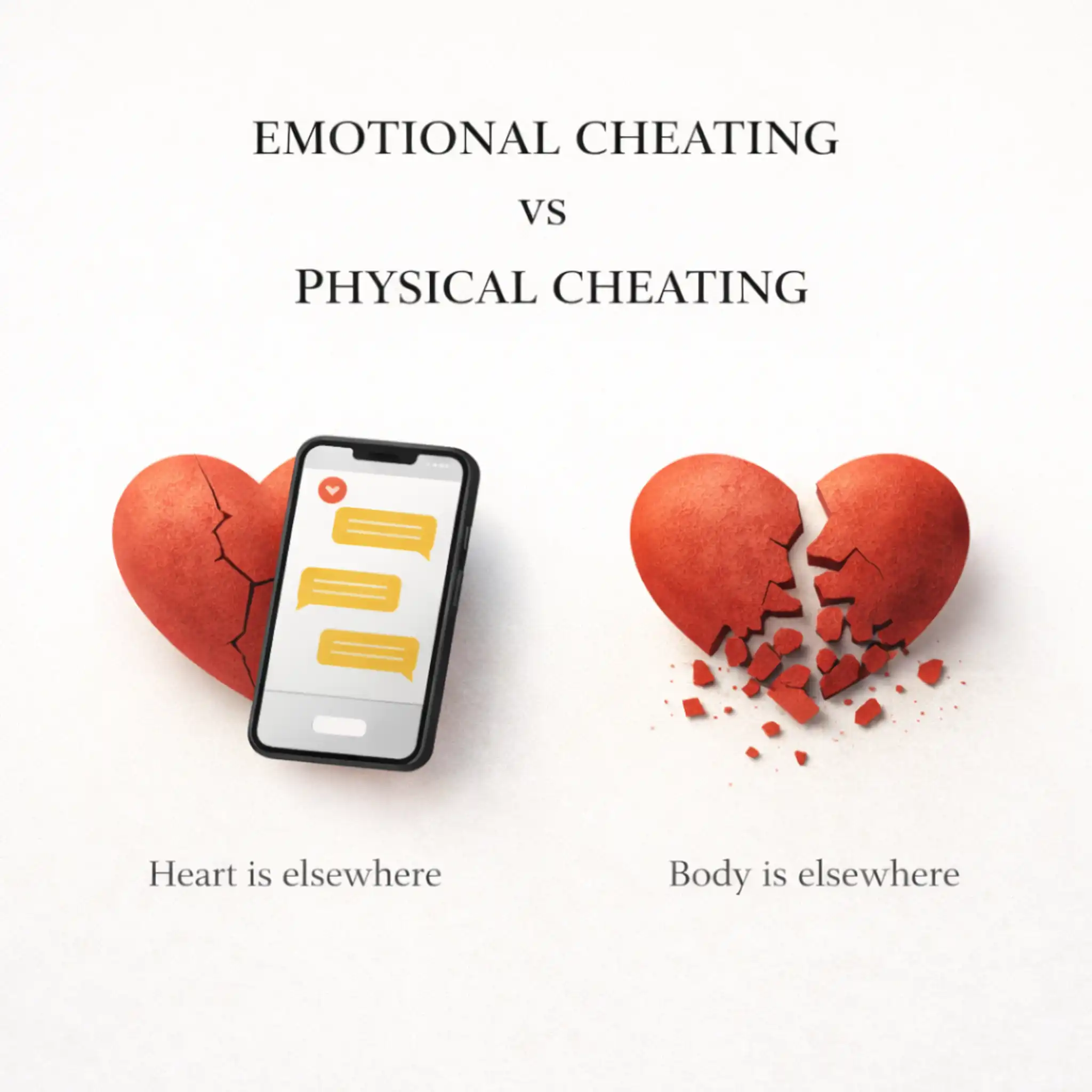
We’ve been asking the wrong question all along.
Not “which is worse, emotional cheating or physical cheating?” But “at what point did honesty become negotiable?”
Because the truth is, people don’t argue about cheating when trust is intact. They start comparing both only when something already feels wrong.
If you listen closely, this debate isn’t really about morality. It’s about how each generation understands connection.
Because cheating doesn’t begin with a body. It begins with a shift in honesty.
There’s a strange generational divide in how we see this.
“Cheating doesn’t begin with touch. It begins with what you choose to hide.”
Talk to someone younger, and they’ll often say emotional cheating isn’t that serious. It’s just talking. Just texting. Just a close friend.
And honestly, it makes sense.
When you’re young, your life is built on multiple connections. You don’t have one person for everything. You have different people for different parts of you.
One friend who knows your fears, one friend who only sees your fun side, one who shows up when things fall apart and then your partner, who is somehow expected to hold all of it together.
But no one really can.
So the lines blur. You just… keep talking to someone who you need at that moment, depending on your needs.
And because nothing “physical” is happening, it doesn’t feel like cheating.
Until you are deleting chats and hiding things from your partner.
“We don’t measure betrayal by what we do. We measure it by what we can’t be honest about.”
A 2023 study in the Journal of Social and Personal Relationships found that most people under 30 only started labeling something as cheating when secrecy entered the picture. Not the emotional closeness itself, just the fact that it had to be hidden.
Which says a lot. How do you know something is wrong? The moment it needs a cover story. But there’s another side to this that people don’t say out loud enough.
Sometimes, that “extra” connection doesn’t come from wanting someone else.
It comes from not feeling understood where you already are.
If your partner questions everything you do, or doesn’t really listen, or makes you feel like you’re constantly being evaluated, you don’t stop needing connection.
You just find it somewhere easier. Someone who lets you be yourself without turning it into an argument and suddenly, you have this space where you can breathe. That space doesn’t feel like betrayal. It feels like relief.
Psychologists call this emotional outsourcing. When your needs aren’t being met in one relationship, you don’t switch them off, you shift them somewhere else.
And that’s where it gets complicated.
Because now it’s not just about right or wrong. It’s about why it happened in the first place.
“But in a long term relationship, physical cheating may shock you, but emotional cheating will break you.”
Now look at people who have been together for years. Not months. Not a couple of years. Decades. Their answer flips completely.
For them, emotional cheating feels far worse than physical and it’s not because physical doesn’t matter. It’s because, over time, the relationship itself changes.
You’ve already been through everything together. Loss, failures, routines, long silences, difficult phases. You’ve seen each other in ways no one else has.
By this point, the relationship isn’t built on excitement anymore. It’s built on familiarity and emotional safety.
In fact, research from the Archives of Sexual Behavior (2021) found that couples in long-term relationships especially over 15 years reported more distress over emotional infidelity than physical. Because emotional connection, at that stage, is the last thing that still feels exclusively theirs.
Also, let’s be honest about something people rarely admit, many long-term couples are not physically intimate in the same way anymore. Life changes that.
So the bond becomes more emotional than physical.
Which is why emotional betrayal feels like a deeper break.
“When you’ve given someone your entire life, what hurts isn’t where their body went… it’s where their heart chose to rest.”
So now you have two completely different perspectives.
One sees emotional closeness as harmless unless it crosses into the physical. The other sees emotional closeness as the deepest form of loyalty and therefore the deepest form of betrayal.
Both feel right from where they stand and that’s what makes this question so tricky.
But maybe the problem is the question itself.
If you are not focused, you risk injury. So you stay present. You feel each movement. You control each repetition.
Because the moment you start comparing emotional and physical cheating, you’re already trying to reduce something complex into a simpler choice. And it isn’t.
Locking one date where all four could be physically present in the studio is a very difficult task.
Locking one date where all four could be physically present in the studio is a very difficult task.
“Cheating is not a category. It’s a pattern.”
So you have two realities. Younger people, where connection is everywhere and lines are blurred.
Older people, where connection is rare and deeply rooted. Both are right from where they stand. But both are also missing something.
You cannot compare. Cheating is not emotional or physical first.
It is a shift away from honesty.
So what do you feel?
Is emotional cheating worse because it takes something deeper? Or is physical cheating worse because it crosses a clearer line?
Or do you also feel like there is no real comparison at all? And more importantly at what point do you believe something becomes cheating?
“Maybe the problem isn’t emotional vs physical. Maybe the problem is that we think cheating needs a category.”
If you are going through any kind of trouble in life, if you feel like you need someone to talk to but are too shy to speak up, use this anonymous feature to send me a message.


1 thought on “EMOTIONAL CHEATING Vs PHYSICAL CHEATING”
Love your take on it.. When u have to hide something – That’s cheating..